
THE PATH
The intention of Spirit Lab is to be a highly practical space for the ones who wish to live in spirit. I wish to delicately convey each layer of spirit in great detail. While the points I present to you may seem “actionable” in this lab, examination – like in all innovative and discovery labs – lays at the crux of finding what is practical and effective.
The purpose of this space is create something that I believe does not exist. A space where ideas and thoughts are challenged. A place where truth (the root of a matter) is found.
Approaching this space with the intention to understand maybe the most effective. You will be exposed to concepts and definitions that you have not heard of before. If it calls you, this can be a beginning for a graert journey.

No Mind – A state of being where your Mind is off
For your whole life, you have had thoughts. A voice in your head. Its always on. Speaking when others are speaking. Speaking as you are reading these words. You have a thought and then you respond to the thought with more thoughts or with actions. The thoughts change, they can be happy one moment and sad the other moment. Your thoughts maybe anxious or depressive and you know this. You know when you are in your head. You know the character of your thoughts, because you and your thoughts are not the same thing. They are two separate entities.
I call these thoughts, the Mind. After all this is where they come from. The Mind also makes emotions and can trigger visceral responses. It is our source of happiness but also our source of misery. Joy and sadness come from the place, the Mind.
Flow State – The early signs of No Mind
You may have experienced flow state, but not have a name for it. Before I continue, I wish to stay that flow state is NOT a mystical experience. It something that you have experienced already. There have been moments in your life when the thoughts in your Mind turned off and you acted from instinct. You did not have to act by the direction of your Mind. You felt with your hands and body and knew what the next step was.

Spirit – The core of a person, ones unique spirit
I introduce this word to you now, because any time you do not act from mind, you have a chance to act from Spirit. More on this coming up.
Lets use an example:
Workout via Mind – before getting to the gym I have a plan. 4 sets of 10 reps on dumbbells presses with 80lbs. 5 sets of 8 reps on triceps extension with 50lbs. 5 sets of 5 reps on bench at 200lbs.
Pros: There is structure for the mind. Your mind knows what you will do next, with what weight.
Cons: Following the plan is the goal. You will be pushing your mind to get every last rep. Once you hit 10 reps you will not do more reps than that, even if you had more in the tank. Your mind will say, “ok mission accomplished”.
If there is not a conscious or planned effort to increase the weight, your mind will keep you at your current numbers. After all it does not want to go through the pain of increasing weight and adding more painful reps.
You may watch youtube videos or get a personal trainer to motivate you or give you tips/tricks. These are external forces that are trying to convince your mind that you should work harder.
You can hear your own thoughts right? Even as you are reading this, your mind is making thoughts. These thoughts may be related to what I have written or they may not be. They could be about something completely different.
Many people counteract these constant thoughts via coffee or stimulants. Some chose drugs on the other spectrum, such as weed or alcohol.
You can, if you desire, turn off these constant thoughts. Your mind will become quiet. I will explain to you why this is possible.
Because you can hear your own thoughts, you are not your thoughts. They are distinct from you – or your consciousness. Your consciousness, like mines was, is accustomed to the constant stream of thoughts. Listening to the thoughts will interfere with your conciousness from listening to your body.
With this reference point, when you have been in flow state in the past, didn’t your mind turn off? When it was off, you did not shut down like a robot losing power. Instead you acted, likely in a way that was remarkable for you. Where did the knowledge to act come from?
Workout Via Spirit
There are two flavors of a Spirit-led workout that I have experienced. The first is an intense desire to lift with everything I have. There is no plan. When I walk into the gym, I do not conscious think about what machine I will do. If bench feels right, I will bench, if not then I will do weighted pushups or cable flys.
The exercise itself does not matter. What matters is my intention. My intention was to lift with everything I have. I want to experience true muscle failure. Each rep is taken through its full range of motion, each rep has a slow pause where there is maximal muscle tension. I promise, I do not have to think, make thoughts, or motivate myself. This is my flow state.
The other way I describe this moment is total submission to the activity. When I lift, it is not about me. I do not lift for me. I lift for the sake of it. I lift because I want to commit myself completely in that task.
See with my mind off, my awareness is available to listen to my body, completely.
With this reference point, when you have been in flow state in the past, didn’t your mind turn off? When it was off, you did not shut down like a robot losing power. Instead you likely acted in a way that was remarkable for you. Where did the knowledge to act like that come from?
I propose that this knowledge was your intuition. Just to plant the seed, I will say, this a small drop of your spirit. You can act from intuition/spirit, not just in activities that put you in flow state, but in every second of your life. In this way, you do not need your thoughts and your mind.
Back to the example of working out, if my mind was off, I could then become aware of each muscle contraction. I would be aware of the position where there was more tension or less tension. Naturally I could increase the time I spent in the positions with more tension. My consciousness would become aware of my bodies posture, its position, and how much tension was coursing through it.
Awareness is called Mind-body connection in the body building world.
The fitness culture calls it the Mind-Body connection and some of these men maybe using their mind the whole time. If so this is an added unnecessary step. You can have Spirit-body connection, which comes natural and easy. You don’t have to “focus” your mind on the body, your complete awareness naturally gets placed on the body.

Why isnt Arnold talking about working out the way I am doing? Why don’t they use the word spirit? Many athletes talk about hard work, training regimens, diets, and drug use- or lack thereof. Its not often that htey talk about total immersion and losing themselves in the game.
The truth is, most athletes do not workout with spirit. The legends, the ones who’s names are mentioned on the dinner table, often do pursue their sport with spirit. Kobe Bryant and Tiger woods have both alluded the ‘spiritual’ aspect of thier training. Those interviews where they feel comfortable describing the “spiritual” aspect of their craft are not often talked about.
Interviewers are looking for the one liner, the 5 step plan, the quick technique hack. Consider how much time you have spent exploring the matter of spirit with me. This is uncommon for most people. The athletes getting interviewed know what the interviewer wants to hear. The answers related to hard work and strategy will help them get the interview over with quickly. Answer related to ones spirit will only lead to more questions or weird looks.
The other way spirit is often used in fitness is an exploration. The athlete explores their physical potential and wants to see the highest limits of what their body can handle. In this way, there is no goal or step by step plan. The athlete simply arrived and is testing their body by exerting it to its limit.
In the two descriptions I described, muscle growth and strength will be a natural byproduct. If one is pushing themselves to failure for the act of it, their muscles will receive a very favorable stimulus to grow.
Every and any activity can be explored via spirit. The whole day can be spent in total immersion of an activity, craft, or an endeavor. Even hanging out with a friend can be done in spirit.
This is a distinction that I wish to make from following someone’s else work out plan or work out strategy. At some point, the work out plan may have worked for the author, but it was one piece in an overaching lifestyle. When other people started copying the plan, they missed on learning why the plan worked and whatelse lead to the person’s success.
You can copy or create a plan that works for you. How do you know your plan is working?
Testing the results. You can write down the weights of your lifts, how many reps you can do, the size of your arms and shoulders. In this way you have an objective reference to track your progress.
Measuring progress in this way can be a feedback loop that allows you to get deeper into the activities that are working and eliminating the ones that are not.
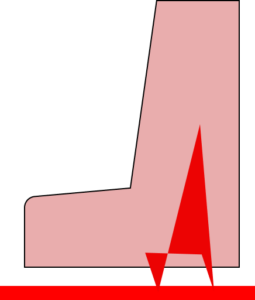
To this point, I will share something else with you. Tension is something that flows through the body. If you are sitting right now, you can press your feet into the ground.
The force you place on the ground, causes the ground to place that force on your feet. That force can then be channeled up to your body. How?
The picture from this page does a great job explaining this concept.
You have the ability to push into the ground, feel the tension in your feet, reposition your hips, lower back, mid, upper back, both shoulders, and arms to feel the tension in your hands which stems from your feet.
This is an underlying principle that I have seen in many athletes, but is most easily demonstrated in rock climbing, gymnastics, and Olympic lifting. What about technique you may ask?
The foundation of technique is easing the flow of tension in your body. The crux of the golf swing is to smoothly transfer the tension from the golf club on its decent towards the ball. In place of memorizing a bunch of steps that do not account for your body’s unique anatomy, you can consider experimenting and understanding the flow of the tension/energy in all the movement you do. Instead of feeling mechanical, you will appear seamless.
There are multiple consequences of testing your own data and tracking your own progress. This leads to a few very advantageous key points that you can apply to everything in your life.
Knowing something personally – There are sayings and quotes that permeate our culture and society. These are shared truths that we have all taken for granted.
For example, it is said that the sky is blue and the sun sets in the west. Have you personally tested these two claims? Have you intermittently gone outside throughout the day to examine if the sky is always blue. Its said the sky is blue, but it is always blue?
It seems redundant to test a fundamental fact – or what is perceived to be a fundamental fact. When examined carefully, it becomes clear that there are subtleties and half-truths in many sayings and statements that are prevalent in society.
Testing the results, Measuring Progress
Measuring your results and getting feedback from your environment is a critical step. Additionally careful examination of the data you receive is also necessary.
I remember in 2010 reading the Leangains blog, which inspired me to start intermittent fasting. It was a 8 hours feeding window and 16 hours fast. I ate from 12:00- 8:00pm everyday for almost 10 years. I thought this was the way. In 2021, I did a deep dive into the literature on intermittent fasting and realized multiple strong studies from 2015 and onward demonstrated a metabolic advantage of eating breakfast and skipping/minimize the amount of food eaten at dinner.
Just by consistently eating breakfast, I dramatically increased my morning energy, which in my profession can be a busy time. I got leaner without any extra inventions, completely avoided the pre-lunch hunger pangs, and slept better because I was not eating late.
Whenever I hear, “i did my own research” and its often that the research was youtube videos, Tiktok shorts, and other peoples blogs, I quickly become cautious. That is not research. That is listening to other peoples opinions.
To me, personal examination has become necessary. When I look at a research paper, I look at the methods and study design. Did they test something that is actually practical?
Then I test it out on myself. Am i able to get the same results they did when I tried what they did? If so, what i did was deeper than “doing research”. I tried to learn something personally. There will still be limitations in what I did, but now I have personal experience in experiencing the thing.
Personal Testing
How do i figure out what works and what doesnt work? – Specifically to accomplish my goal.
Unfortunately it’s not as easy as finding an expert in the field and copying what they did. Take for example, investing in the stock market. Many interviewers have asked Warren Buffett how he amassed his wealth. After reading his book and watching his interviews, I acknowledge that he has an idea of what works for him, but the critical details he cant not explain.
The intuition and gestalt that he has gained after being in the market for as long as he has cannot be written in a book.
He acts upon intuition, which is a feeling that comes from his bones, different than an emotion.
Jeff Bezos once said: “All of my best decisions in business and in life, have been made with heart, intuition, guts, not, not analysis. When you can make a a decision with analysis, you should do so. But it turns out in life that your most important decisions are always made with instinct, intuition, taste, heart”
How can you and I develop that feeling, that intuition?
How can we test and figure out what exactly works for us?
What has worked for me is having an awareness of my intuition and then testing it to see if it gets me closer to my desired outcome.
Some examples I wanted to identify were ways I could be more productive at work.
I began recording my production, by writing down how many billable units of work I did every hour.
I was able to see what times I was the most productive during the day.
To optimize and understand my production, I started to add specific variables.
I changed what I ate for lunch and added supplements. After every change, I evaluated if there was an increase or decrease in my production.
What I found was no intervention drastically changed how much I produced. Ultimately my production was higher in the afternoon, regardless of the interventions I made in the morning.
Then I examined how much work was available throughout the day. It turned out that the afternoon and evening had more work available, which allowed me to be more productive.
Then I shifted my work time to the busier hours and made the same production in 5 hours in the afternoon as I did in 8 hours in the morning.
Some more examples.
I have done this a few different times, usually lasting for a span of 3 months, where I track every penny spent and every calorie and macro that I eat.
I don’t aim to make any changes. I am just trying to understand where I am at. This practice allows me to naturally gravitate towards cutting out expenses and calories (often tied together) that aren’t serving a purpose.
I don’t have a goal when I do this. I just want to understand. Taking action with that information is an easy, natural step. If I wanted to aim for a goal, having that depth of information, would allow me to make an effective move.
There is a pitfall I would like to share, as I have seen how objective measurement is often incorrectly used. Personal testing is a tool to identify what is effective and a way to eliminate your biases. When used as incentives or for punitive reasons, the numbers can push one away from finding whats effective.
A hospital I worked at started an initiative to track surgical site infections.
They created a check list that allows the nurses on the surgical units to click and report a surgical site infection. There were other initiatives done in the operating room where
the surgical sites were double cleaned and special dressings were used.
At the end of six months, there were less then 5 surgical site infections documented, which was a sharp drop from the previous six months. The hospital administration threw a party, touting their success.
Five to six months after the celebration, someone on the safety team came across a file with the surgical site complaints. Turns out that the computer system was logging the infection events in the wrong place. There was no significant change in surgical site infections.
Another example that I have witnessed is hospitals keeping track of catheter-acquired urinary tract infections. If I leave a tube in someone’s bladder, they have a higher risk of developing a urinary tract infection. In order to circumvent getting dinged or marked for having a catheter-acquired infection, patients who were suspected to have such an infection were given antibiotics and a new catheter without testing. This way, a catheter-acquired infection could not be proven and thus would not be documented. Measuring the wrong thing, along with punitive actions, are more likely to be a problem in organizational settings, but can also happen in your personal testing. Something to be cognizant about and aware of.
Many times I am presented with a piece of information or advice. Instead of taking it at face value, I often test it firsthand. Whatever the matter is, I test it personally. This way, I have personal knowledge of the matter.

Understanding
I became exposed to the word “prescription” on my journey to peace.
The word works in many ways.
When you go to the doctor, they give you a prescription with instructions on how to take a medication. The doctor doesn’t explain why the medication is needed to be taken twice a day instead of once a day. They don’t explain why you have to take 100 milligrams instead of 200 milligrams.
They simply give you the name of the medication, its dosage, and how to take it.
Similarly, a recipe to make cookies doesn’t explain why one cup of flour was used instead of two cups.
In these simple tasks, someone has an understanding of these topics, does some experimentation, and reaches an ideal outcome.
They then retrace their steps and write down a list of instructions.
For many things, like changing a tire, baking a cake, applying for a driver’s license, these steps are effective.
The more simple the task, the better these work.
Where they fall short is the creation of something new, or when someone trying to achieve an outcome that is remarkable, outside the norm.
In these circumstances, the prescriptions fall short.
In order to master something, I find myself having to understand each piece of the activity and how they operate together.
I then have to experiment with all the different pieces to find the permutation that works the best.
This experimentation, personal testing, and knowledge of all the pieces leads to a deep understanding.
This is different from following a prescription.
Reliance on prescriptions can be dangerous.
Let’s say, for example, if you used a recipe to bake a cake and followed it to a T and the cake was not edible, you would then look for a different recipe.
The focus is on finding a better recipe, not on understanding how the raw ingredients combine and change form to become a cake.
It requires less effort to follow the instructions of an expert instead of learning the matter yourself. This a major limitation of looking for prescriptions.
By persuing undestanding of a matter, you have a chance to get to its core. When you persuing understanding of yourself, its called self-examination. More on this ahead.