
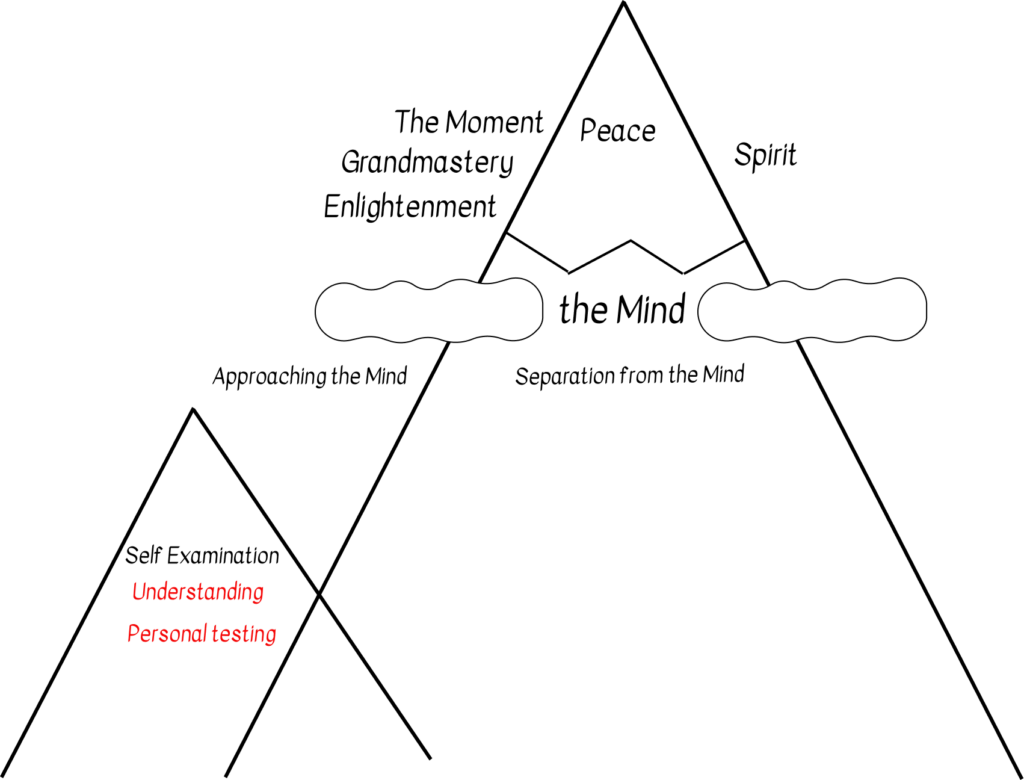
THE MIND
Self - Examination
Understanding the core of yourself. Before you get to the core, you may find it necessary to understand many of the superifical layers.
Another word for Self-examination is introspection.
The way I examine myself is to ask myself “why?”.
At every level, I ask why.
And I try to get deeper.
An example:
M (mind)
C (consciousness/Spirit)
M- I want something sweet right now. I just had dinner. It will be nice.
C – why am I craving something sweet after dinner?
M – Because I just am. It’s been a long day.
C– Okay, but why?
M- Maybe because it’s customary to have dinner at the end of the day.
C -Okay, but why are you upholding this particular custom? You don’t have to.
M – Well, my brain habitually wants a dopamine spike that sugar provides.
C– Okay, got it. Why are you inclined to provide that dopamine spike?
M – Because it feels good.
C– Why do you want to feel good?
M- I just do.
C -Why?
M – So I don’t feel bad.
C– Why would you feel bad?
M – It’s not because I’m craving something sweet. I want to feel good. If I dont feel good, then I will feel bad.
C – Why is feeling good so important to you?
M – I don’t know.
When you don't know something, something magical can happen. You have a chance to examine, experiment, and find out.
In the above example, no amount of logic could counteract my desire for dessert.
Bad for my teeth, body wide inflammation, skin breakout, the list is endless. The desire is unrelated to the function of knowledge. The only way to master this desire is to know it firsthand and know all of its facets, tactics, actions. This pursuit of going deeper has allowed me to get to the depths of my being.
It has allowed me to look into the deepest darkest, darkest places of my mind.
I keep digging to the I don’t know stage.
From there, I can look around. I can test. I can feel.
When I find a potential answer, I test it.
Going back to the example of wanting dessert.
Why do I want to feel good?
One potential answer is that I’m dehydrated and my brain is responding to signals that my mind is incorrectly perceiving.
If I drink a tall glass of water, does that resolve my desire to wanting dessert?
I can test it.
If the glass of water doesn’t do it, I go back to the place of I don’t know.
Maybe to feel good, I can go for an evening walk. Turns out, I feel good walking, but I still crave the sugar.
Back to the place of I dont know.
Maybe my brain is addicted to evening sugar. What happens when I force myself not to eat dessert? After three days, is the craving is gone?
This isn’t rocket science. I don’t have to read a book on it or to ask chatgtp.
If I find the answer for myself, I know it, forever.
The biggest barrier to self-examination is the pain that arises when you see yourself acting in a way that's self-destructive
My example of evening dessert was benign. Let’s take another example with a friend that wanted to examine something deeper.
Friend: Every time I go out in a social environment, I want a drink.
Me– Why?
Friend – I don’t know. That’s what people do. That’s the culture.
Me – Why do you desire it? There are things the culture does that you don’t.
Friend – To fit in. I don’t know.
Me – Why is fitting in, in that way important to you? You want to talk to me about social drinking because there is something about it that you don’t like or maybe examining.
Friend – Yeah. It’s more than wanting to fit in. I just feel anxious when I talk to strangers. A few drinks takes the edge off.
Me– Why do you feel anxious when talking to strangers?
Friend- I think it’s common, you know? Fear of judgment. I suppose
Me– Why do you fear the judgment of a stranger, someone you’ve never met before?
Friend – I don’t know, sometimes I feel like I will say the wrong thing.
Me– You feel like you will say the wrong thing to a stranger and they will judge you?
Friend- Honestly, I have this anxiety about judgment and everything. I don’t know why I care so much what other people think about.
Me– Why do you care what other people think about you?
Friend – I don’t know man, I just told you I don’t know.
Me– Okay, we will wait and see what comes to you.
Friend – I hate talking about this. I was bullied as a child and my mom was super judgmental, it stems from my childhood.
Me– Why is something from your childhood impacting you today? You’re in your mid-twenties, childhood was a decade ago. Why is it still here?
Friend – Just like everything else, isn’t it. We all have our inner child that we revert back to, Sigmund Freud, bro.
Me– I am just trying understand. Why do you think you have an inner child that you revert to? Do you occasionally lose the ability to walk and relearn it? Do you forget bladder control and get potty trained again? Just trying to get a better understanding.
Friend – No, of course not, I don’t know, man, what do you think?
Me – I don’t think anything. No judgment here, just trying to understand. Why are you hanging on to your childhood trauma?
Friend – Man, I hate this, fuck, I don’t know who I’d be without this.
Me– Can you let this trauma go?
Friend- Not without the help of a therapist.
Me– If you were given a chance to let this trauma go at this moment, would you take it?
Friend – Yes.
Me – What would you be willing to give up to let this trauma go?
Friend – What do you mean?
Me– How uncomfortable would you be willing to be to face this trauma and let it go?
Friend- Oh, man, I don’t know. (two minutes later) I’ll do whatever it takes.
Me – Can you tell me all the ways this trauma impacts your life?
Friend – (two minutes later) It’s hard to open up, get vulnerable. The drinking is more frequent than just socially. I drink every night. If I don’t have a distraction, the anxiety comes back, it’s like I can’t live with myself.
I may slip up and say something, and others would know that I’m just hanging in. It affects everything.
Me – Do you think you have a chance to let this go?
Friend- How?
Me– It’s an intention. If you wish, close your eyes, face it head on, breathe in and out, release, forgive, forget. If you make the intention, it will go away, and you will know how to get it out.
Friend- (10 minutes and tears later). I see it. I can let this go. I know what i have to do.
Your journey will be similar, no therapist required, just an intention to find the root cause, not giving up at any level, going wherever the journey will take you. It will take many sessions and more than 10 minutes, but every deep dive will create significant changes. Enough deep dives and transformatinon will happen.
What will prevent you from this level of self-examination?
Distractions – music, TV, sports, YouTube commentaries, video games, blog articles, fashion, mindless shopping, eating, literally anything that is not directly related to self-examination. It is a painful journey to see how much we sabotage ourselves.
Distracting ourselves endlessly is the most common way to delay addressing our anxious thoughts.
Approaching the Mind
Distractions
Distractions are like bullet wounds, each one hurts, your mind and body. The amount of time it takes to recover is exponentially linked with the amount of distractions you get hit with.
Warren Buffet on the one word that lead to his success (also used by bill gates): focus.

Pushing yourself to focus hardly works.
In my own life, focusing on something I don’t care about is nearly impossible. There was no way I am going to be amazing at it. I’d be lucky to be above average.
How do I focus?
A better question is, what stands between me and my focus?
For me, it’s working on the thing that I’m naturally interested in, and then removing everything else that won’t get me closer to that thing.
The focus is a natural consequence when the environment is ripe. If you ask me to write this in a nightclub at 1am, it won’t work.
No matter how much I want to.
At 5am, after a night of rest, before the sun rises, the words flow without effort. A life without constant distractions is peaceful.
Initially, a life without distraction can be felt as boring.
There’s no music. There’s nothing on TV or in the background. It’s quiet and there’s not much to chase after. This brings us to the idea of stillness.
Being completely at ease, so much so, that your body and mind become still. You can’t force this, but in an empty room with a blanket and pillow, stillness can arrive.
When there is nothing to do, to respond to, you can disconnect. Your thoughts may run, but you distance yourself.
It’ll just be you and your breath.
Soon you’ll sync with your breath and just be present.
This is a liberating moment. The world is spinning but you are still.
As I mentioned above, your thoughts may run. These are signals from your mind. One aspect of self-examination is to view the thoughts from afar. The thoughts are not you. They are not your consciousness . There have been moments in your life where your thoughts were racing.
Anxiety or depression – you know when your thoughts are racing so you are not your thoughts. They are present but they are not yours.
Once you break the connection, you can view the thoughts and examine them just as anything else. This will allow you to find the origin of the thoughts which is from the mind. From there transcendence of the mind is a possibility.
How do I Focus? By removing all the things that stand in the way. From there, focusing becomes effortless.
Separation from the mind
With intention, I became aware of my mind’s voice, thoughts, patterns, emotions. I noticed when it got louder or softer. Then I became aware of my own consciousness. The mind was different than me. It began to feel like a foreign voice. At this point, I made a conscious effort not to entertain my mind and instead feel what is my consciousness.
This was a summit in the journey to no-mind.
My proverbial Everest.
A few events naturally occurred at this time. I became aware of the persona that the mind had created for me. This was a character that had some traits, strengths and weaknesses. I walked away from this character.
This was my sense of self. It can be scary to walk away from your sense of self. There is a feeling of weightlessness or uncertainty. If all your life you have been chained to the ground, walking free, jumping, even flying are all intially frieghtening. Once you realise the possiblities, you can be free.
You can float anywhere and immerse yourself in anything.
The ideas, life events, people that previously changed your mood, have no effect.
Similarly, I experienced neutrality.
The mind likes the dichotomy of the red pill or the blue pill. It likes to take sides. It enjoys the extremes. In groups vs out groups. This is how the mind can take a mental shortcut. Someone or something is either all good or all bad. This way the mind does not have to get to know them.
With my mind off or very far away, I became aware of all the negatives of living in the extremes.
I began to understand that the truth is not an extreme.
The reality behind something is always somewhere in the middle.
I don’t care to pick sides.
I dont have to be team red pill or blue pill. I dont have to vote red or blue. I can live far away from the extremes and the sides. In this way I have a chance to see whats real…

Reality
I want to know reality, but how can I know what reality actually is?
I have to perceive it firsthand.
I have to get personal validation in the matter.
If someone says the sun sets in the west, I want to go outside and personally validate it.
Any recommendation, advice, review, I want to observe it firsthand. Otherwise, I hold no opinion on the matter and don’t wish to discuss it.
The Consequence, A Path Alone
Without a self-image, without being on a side, I naturally became someone quite different from my peers.
This was both freeing and scary. There was no team to join.
What is interesting is that there was never a team to join. The mind creates a feeling that you are a part of the group.
But in reality, a group is loosely connected. Not everyone who goes to church believes in God. Not everyone on the basketball teams wants to be there. Even in personal relationships, enemies can spend a whole weekend together.
Without being attached to a group, you begin to see people’s true intentions. You can see why people are choosing to show up and momentarliy be a part of the group.
When you being to believe in nothing, you have no enemies. Everyone and anyone can be your friend. All the groups in the world become an opportunity for you to enter in and exit without consequence.
The different path is what you make of it.
I found myself disconnecting from media, news, podcasts. I can’t tell you what’s on TV or what movies are coming out.
I don’t even know who the vice president is. That information is unnecessary for where I want to go.
Not being cultured in society, TV shows, media, or sports allowed me to form deeper relationships.
I talk to people about what matters. Their fears, anxieties, and deepest darkest matters. All my relationships deepened.
With some foundational principles in place, let us approach the crux of the matter. The Mind itself.
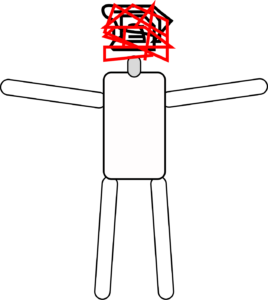
The Mind
Specifically refers to the voice in our head. The thought generator.
The Mind is different from our brain, which is an organ.
For most, this thought generator is always on. While you are reading these words, you are speaking them in your head.
This is your mind speaking these words. Your attention will then go to any thought your mind makes and you will zone out. As your reading these words, that zoning out maybe happening. To concentrate you will have to push the thought out, with your mind, which by definition is making another thought. Once the thoughts pass you can then go back to reading the point where you lost your focus.
Not being able to focus is a common occurrence.
For one reason or another, we are unable to focus on one task. It may be due to external distractions, but more often, its our own thoughts. We are reading something, and then all of a sudden, a thought comes in and shifts our focus away from the matter in front of us. Then, we must bring our focus back. This feeling is often described as “cant focus”.
But it is better explained by “cant focus on the right thing”. Afterall we were focusing on something and then we focus on something else, which distracted us from the matter we were originally focusing on.
To counteract this, people use caffeine, stimulants, isolation, and many other tactics. While these may be of some benefit, they dont address the root of the problem.
For many people, the mind act simliarly to this:
The mind presents a thought: “Its cold in here”. Our consciousness recognizes this thought. Then the mind presents another thought “I hate how cold they set the temperature in here. I wonder why they want to torture employees.”
Then an emotion begins to form. An emotion of discomfort, dislike, and unhappiness. Then an action is taken to suppress this emotion.
I may get up and walk around, turn on music, or check my phone. This is a distraction from the emotion that was presented from a thought by the mind when it said, “its cold in here.”
In this space, emotion refers to anger, happiness, joy, sadness, jealousy, and insecurity. I reserve the word feeling for something else.
Many people use the word feeling in place of an emotion. It is often said, “I am in my feels.” I wish to make this distinction. Emotion comes from the mind. Its fleeting, its comes and go quickly, like fireworks.
Intuition comes from another place. Intuition is felt deep in ones bones. Its a kin to mining a deep earthly metal. Once you have it in your hands, its its something that can be relied upon. When I use the word feeling in the space of Spirit Lab, I am referring to feeling the intuition.
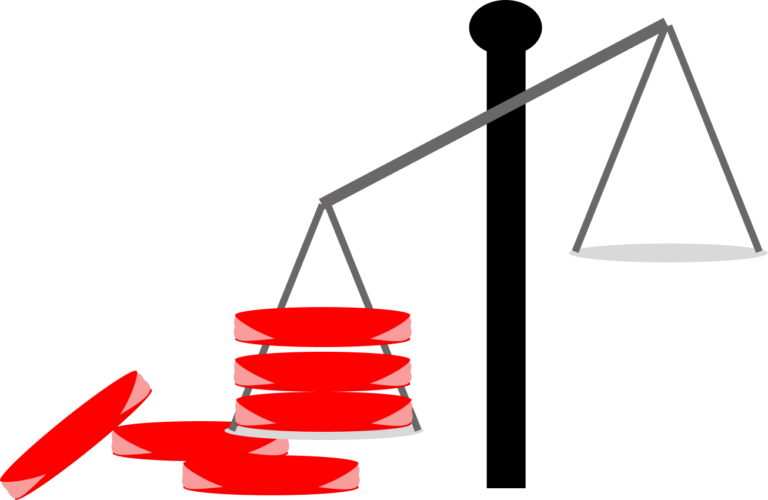
The mind also relies on habits. There was a time when I took the same road to work daily. One time I had stopped on the side of the road to help someone in a car accident. Often, whenever I drove past that spot, my mind would trigger a chain of thoughts. It would say, “ah, that one time I stopped by a car accident. That was crazy. That guys leg was badly injured. I bet he got an emergency fixator and surgery five days later. He probably cant walk normally anymore. Its wild that I did that. Remember that one time I got up for an airplane emergency? Man, Im wild.”
Most of the time I drove past that spot, I had a similar chain of thoughts.
What I described to you is the Mind – presenting a pre-made script of thoughts, over and over again. This is one of its most benign forms. Can you imaging the pre-made script that gets played in stressful situations?
An example at a bigger scale of the mind is opinions.
Take for example, the, polarization of the black lives movement and the blue lives matter movements of 2020. People around the world witnessed a horrific crime and then subsequently witnessed other crimes.
Due to preconceived notions or social influence, they formed one of two opinions. Either black lives matter is good or black lives matter is bad.
If they formed an opinion that black lives matter was good, then their mind immediately created an in-group versus an out-group, all good or all bad.
If they stood up for black lives matter, they subscribed to all the beliefs that that were pro-black lives matter without examining them.
If they had the preconceived belief that that black lives matter movement was bad, they subscribed to all the opinions in the herd of blue lives matter.
By adopting a side, people on both spectrums are unable to appreciate the subtleties and the viewpoints of the opposing side.
The opposition of the black lives matter is unable to see that the movement is a reflection of years of documented systemic policy that disproportionately impacts one race. https://pmc.ncbi.nlm.nih.gov/articles/PMC4504294
The black lives matter is good side does not want to entertain the invaluable role that police officers have in society. No matter how you vote, when you fear your life, you call the police.
Like everything, the truth is somewhere in the middle.
Retraining the police, performing careful examination of legislation, law and policy are very difficult and are time-consuming tasks.
Its easier to go and rally and participate in “the movement”, as oppose to examining the law book, read the fine print and personally assess what exactly is going on. Having a discussion about redistributing funds away from police militarization towards a more nuanced police strategy, requires attention, detail, and personal examination.
Often the mind does not want to have a nuanced discussion, which is heavily resource intensive. It wants to form an opinion. If there are sides, it will join one of the sides. Can you imagine the limitations of this all or nothing thinking, especially in today’s political climate?
The Mind also presents beliefs.
Belief in God is very common. Often those who believe will filter out everything that goes against their belief. They will hang on to science and theology by scholars, who share the same belief, and who present commentary supporting preconceived beliefs.
Those who dont believe in the presence of a God will not entertain any evidence that may indicate the presence of a God.
The Mind has a tendency to make beliefs all or nothing things.
As I mentioned above the truth lies in the middle.
The Mind is the source of our self-image. It creates a fictional character who has roles and strengths. My Mind creates an image of being a doctor. The Mind then populates the details of the self image of this doctor who has tendencies and traits and strengths. Whenever I fail to do those things, the Mind experiences dissonance. The Mind will then change its memory of the situation to match its own self- image.
By understanding all the ways the Mind works, you have a chance to see when the Mind becomes active.
For you, the Mind may constantly be on. You also may have had certain activities which turned off your Mind – the voice in your head- and you can consistently achieve flow state where you are all in and be completely engaged in the activity.
After exploring some of the ways of the Mind, you as the reader have an opportunity to identify your Mind, right now.
There have been times in your life where you knew your Mind was going crazy, moments of stress and anxiety caused your mind to race. You also may have heard depressive thoughts that your Mind was presenting. These are times in your life where you are distinct from your mind. You know the Mind is going crazy, so you are not your Mind.
A psychologist may recommend changing your thoughts or doing something that changes those thoughts. Fire can not be fought with fire. These attempts, while they may bring temporary benefit, do not help at the root of the matter.

There is an alternative path. The alternative path is to recognize when your Mind is going active and to take a step back. Once you feel that you are not your Mind, you will find yourself not responding to the Mind. When you don’t respond to the Mind you are free to act in the way that best suits you. You are not tied to the the Mind and its ups and downs.
The opinions, beliefs, egos, that your Mind will present will not change your internal state. In this way you may realize that you are not your Mind. Your Mind is a foreign voice. You, yourself is a consciousness. For now I will call it spirit. Your consciousness or spirit is different from your Mind. When you can separate yourself from your Mind, you have a chance to turn the Mind off.
The way to turn the Mind off is not mechanical. Its a gut feeling. Its a place your conciouness goes to, where the Mind feels far away. The first time it happened to me, conciously, was a momunmental moment. The characteristics of this place were so delicate. My conciousness found a place in my heart and I could lean into. It took repition for me to consistenly find this space. The more I learned about the my Mind, the easier it became to sperate myself.
Separating from your Mind, has a number of benefits that naturally arise:
Calmness
Peace
Zen
Focus
Nothing between you and the task
To see the world as it is
In my personal journey, I encountered a particular road block with my Mind.
The Mind allows one to feel good or feel bad. Feeling good often occurs when the brain releases dopamine. Remember the brain is different the Mind. Dopamine release can happen for a multitude of reasons: drugs, hard exercise, and effort. There is a perception that neurobiology can change the Mind.
This effect is marginal at best. Your body may experience positive emotions and less of the negative emotions, but the root of the emotions was not addressed. For me, in order to sperate from the Mind, I had to walk away from the desire to feel good. When I did this, I experienced something far more meaningful. Trading feeling good for peace and Zen became effortless.
Conquering the Mind has a connotation that one used their Mind to conquer itself. This does not work. The Mind can only be be conquered when it is separated from and observed from a third party position.
When you realize you have a Mind and that you are distinct from it, you can create space between yourself and your thoughts and emotions. As you choose to pursue tasks, your Mind will naturally follow. When you want ideas, your Mind will present them. When the mind presents an opinion, it is examined but not automatically acted upon. There is a recognition of all of the tactics of the mind. This is the feeling of conquering the Mind.
As mentioned before, the endeavor reveals many natural powers.
Being free of the mind, opens the opportunity to experience the Moment.
The Moment
Separation from and surpassing the mind is a beautiful experience. It allows one access to unique life experiences. With the mind off, resting quietly, you can access the moment. It’s often said, “be in the moment” or “I was just dialed in”.
These are all very similar to a commonly described physiological state called flow.
Flow state is often described as getting lost in an activity or hobby.
In Spirit Lab, I’m exploring being in flow state 24-7. Everything I do, I want to be completely tuned in.
Even something mundane can be approached with the lens being all-in. What are the things that prevent me from being all-in today, right now?
In my examination, I found it was my desires, beliefs, and ego.
How so?
Desires
Often when working on a task, such as writing this blog, the creative moments are the minority. I love to express the feeling, to put it out there. And then to revisit. To see if it holds.
On the back end of digitally posting this content, I have to co-manage the technical aspects.
While I have a web developer who assists me on the back end, code -based things, a significant portion of my time (longer than the creation of the content) is spent on tasks that allow this post to be read by you.
It’s not pleasurable to me to engage in these technical back end tasks. During the time that I spend these tasks, my Mind often triggers a desire for me to eat something that it likes.
Even as simple as eating an apple will take me away from the task at hand. By taking me away from the task and my reinforcing this pattern of acquising to my desires, I lose the ability to completely immerse myself in the task at hand.
This is but the smallest of desires. There are many bigger ones. Can you identify something things that your Mind presents during tasks that you don’t want to do?
Beliefs
Specifically examined in relation to flow state.
Beliefs are preconceived notions about how something should be or be done.
In flow state, preconceived notions are not valuable.
In flow, it’s not a matter of what was or what has been done.
What holds the most weight is the matter right in front of me.
I don’t need beliefs if I’m trying to understand what I’m doing right now.
Ego
Specifically a sense of self, often related to self-image.
The flow state and the moment are opportunities to experience dissolution of yourself. You don’t feel your own sense of self.
You and the thing you are exploring are one. This feeling is uncommon but maybe something you experienced before. You are so immersed in a task that it is hard to find yourself in it.
I will describe my experience working on this blog:
I’m not writing. The words being put on this page are not coming from me. They’re just being written. The energy flows through me. The feeling is that is being shared is no different than me.
There are no barriers for me. I do and write just as I feel. This is the moment. This is being without myself.
Being in the moment unlocks some superpowers.
When you watch Kobe dribble the ball down the court, with 10 seconds left in a tie game, nothing he is doing is for the fans. It is just the moment.
He is not checking his posture or his smile. He’s not performing. He’s just moving in the way that his intuition tells him.
Amazing performances and noteworthy art are moments. They don’t happen often. When they occur it is a sight to see.
The accomplishment is noteworthy, but more important is the feeling of observing someone completely in tune with their craft.
To summarize, flow state can be experienced 24/7 by you and I. Understanding what limits us from flow state increases the likelihood that we are in flow state. Another way to describe flow state is no mind.

Enlightenment
What happens when we apply the no Mind state to our introspection?
We experience Enlightenment. It is introspection without the mind.
What is the experience like?